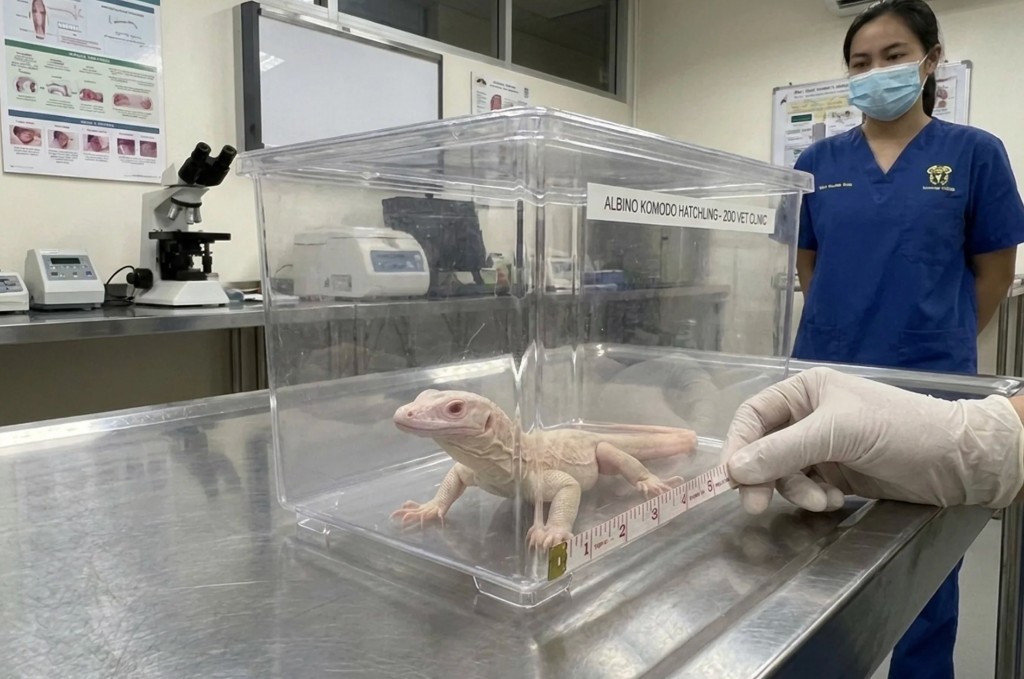
CZS are delighted to announce that today, our Komodo dragon breeding programme produced something that has never been recorded before, a fully albino Komodo dragon hatchling. We would love for you to help us choose her name, with voting details at the end of this article.
Staff first noticed something unusual during a routine check of the latest clutch. Instead of the mottled grey brown scales typical of the species, one hatchling emerged with strikingly pale, almost ivory white skin and pink eyes, the unmistakable signature of albinism.
"In over 20 years working with reptiles, I never expected to see this in my career, let alone at our zoo," said our Head of Reptile Conservation. "We ran the checks three times because we genuinely couldn't believe it."
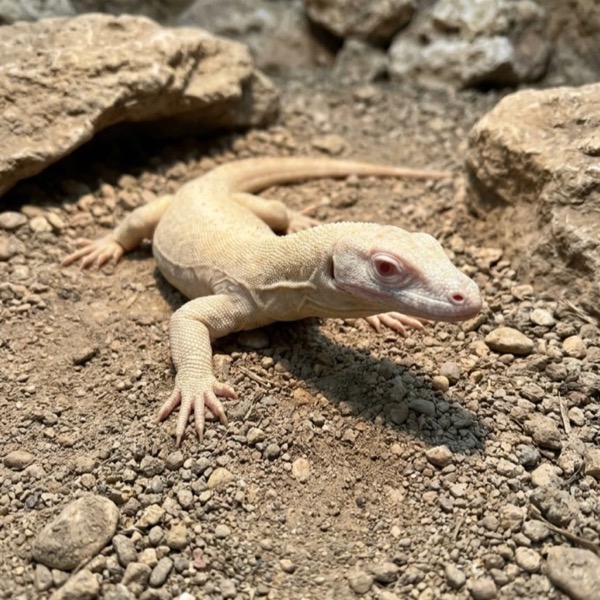
Komodo dragons are already one of the rarest large predators on Earth. The entire wild population, found only on a handful of Indonesian islands including Komodo, Rinca and Flores, is estimated at just 1,400 to 3,000 mature adults. As the largest living lizard species, they can grow up to 3 metres long and are formidable ambush hunters, relying on camouflage perfect mottled scales to stalk prey undetected.
That camouflage is exactly why albinism in this species is so extraordinarily rare. In the wild, a pale coloured dragon would struggle to hide from prey, and from other Komodo dragons, since cannibalism among juveniles is common. Albino animals also face additional challenges, including heightened sensitivity to sunlight and a higher risk of predation in early life. Combine that with the tiny total population size of the species, and you get a genetic event so unlikely that, until now, it had never been officially recorded in this species, in the wild or in captivity.
Komodo dragons also carry another remarkable biological trait, as females are capable of parthenogenesis, meaning they can reproduce without a mate under the right conditions. While that is not how our hatchling came to be, it is part of what makes this species endlessly fascinating to the researchers who study it.
Our hatchling currently weighs in at just under 100 grams and measures approximately 40cm nose to tail, tiny compared to the 70kg plus giants she will grow into over the coming years. She is currently being closely monitored in a specialist enclosure with carefully controlled lighting, given her sensitivity to UV exposure.
Keepers report she is already showing the same feisty independence typical of Komodo hatchlings, who in the wild spend their first years of life up in the trees, safely away from adult dragons, before descending to the ground as they mature.
Every dragon deserves a name worthy of her story, and we want you to help us choose it. Cast your vote for your favourite below, or leave your own suggestion in the comments.
Vote for her name
Voting closes on 30th August and the winning name will be officially announced at a special naming ceremony here at the zoo. Be sure to keep an eye on our social media and website for more updates.